 English
 русский
 Español
 عربى

Home / News / Industry News / Best Mattress Topper to Make a Bed Softer: A Hotel Linen Maker's Guide
Best Mattress Topper to Make a Bed Softer: A Hotel Linen Maker's Guide


Best Mattress Topper to Make a Bed Softer: A Hotel Linen Maker's Guide
2026-11-16
Content
- 1 Why a Bed That Feels Too Firm Is Rarely a Lost Cause
- 2 What "Softer" Really Means: Surface Softness, Pressure Relief and Sink
- 3 The Main Types of Mattress Toppers Compared
- 4 Loft and Fill Weight: The Numbers That Quietly Decide How Soft a Topper Feels
- 5 The Cover Fabric Matters More Than Most Shoppers Expect
- 6 Down and Feather, or Microfibre? A Two-Column Answer
- 7 Matching the Topper to How You Actually Sleep
- 8 Topper, Pad or Protector? Getting the Layers in the Right Order
- 9 When One Firmness Does Not Suit Two People
- 10 Care, Washing and Rotation: Keeping the Softness You Paid For
- 11 What Hotels Do Differently, and What Is Worth Copying
- 12 A Practical Checklist Before You Buy
- 13 Frequently Asked Questions
- 13.1 What is the best mattress topper to make a bed softer?
- 13.2 How thick should a topper be to noticeably soften a firm mattress?
- 13.3 Will a topper make my bed too soft and hurt my back?
- 13.4 Are memory foam toppers good for softening a bed?
- 13.5 Can a topper be used on a sofa bed?
- 13.6 How do I stop a topper from sliding?
- 13.7 Do I need a topper if I already have a mattress pad?
- 13.8 How often should a mattress topper be replaced?
There is a specific kind of disappointment that comes from climbing into bed after a long day and meeting a surface that feels like a table with a sheet pulled over it. You turn once, then twice, punch the pillow, and start doing the mental arithmetic of how many hours of sleep you have left. We have spent more than twenty years making bedding for hotels, and the question of how to soften a bed that has gone too firm comes up in almost every conversation with housekeeping teams, purchasers and, honestly, our own friends.
A good mattress topper is the least expensive, least disruptive fix available. It does not require replacing the mattress, it does not require a new bed frame, and in most cases it can be on the bed before the weekend. But "soft" is one of the most misused words in bedding. A topper that feels like a cloud in the shop can turn into a sweaty, sinking hollow by two in the morning, and a topper that feels firm to the hand can be exactly the right amount of pressure relief for a side sleeper with a sore shoulder.
The short answer, if you only read one paragraph
For most people who simply want a too-firm bed to feel plusher, a microfibre-filled topper with roughly 5cm to 8cm of loft and a downproof cotton cover is the safest starting point. It softens the surface without swallowing your body, it breathes reasonably well, and it is easy to clean. Down and feather gives the most luxurious sink, memory foam gives the most contouring, and latex gives the most bounce, but each of those comes with a trade-off that is worth understanding before you spend money.
What follows is the same advice we give when a hotel asks us to help rescue a room category that guests keep describing as "hard". It is organised around the questions that actually decide whether you will be happy three months from now, not just on the first night.
Why a Bed That Feels Too Firm Is Rarely a Lost Cause
Mattresses do not usually become dramatically firmer overnight. What changes is the relationship between the mattress and the person lying on it. Before you buy anything, it helps to work out which of these four situations you are actually in, because they call for slightly different toppers.
The mattress has aged
Foam and fibre layers compress unevenly over five to eight years. The centre of the bed loses height, the surface feels flatter and harder, and pressure concentrates on hips and shoulders.
Your body changed
Pregnancy, injury, weight change or a new exercise routine can make a surface that was fine last year feel unforgiving. This is often the fastest case to solve with a topper.
The mattress was always firm
Many supportive mattresses are deliberately hard on top. Hotels buy them for durability, then add a soft layer above. You can do exactly the same thing at home.
Only one side is unhappy
If your partner sleeps well and you do not, the problem is probably pressure rather than support. A topper with some give is often enough to close that gap without buying two mattresses.
There is also a seasonal element that people underestimate. Cold rooms make foam stiffer and fabric feel tighter, which is why a bed can seem harder in January than it did in June. A topper adds a layer of insulation and cushioning that smooths out some of that variation, though it will not fix a mattress that has genuinely collapsed.
One rule of thumb from our own production floor: if you can press your hand into the mattress and feel the springs or the base through the surface, a topper will help but it will not rescue the situation alone. If the mattress still supports you and only the top layer is unforgiving, a topper is almost always the right purchase.
What "Softer" Really Means: Surface Softness, Pressure Relief and Sink
Shoppers tend to use one word for three different experiences. Separating them makes the choice much easier, because a topper can be excellent at one and mediocre at another.
Surface softness
This is what your palm feels when you press down. It is created by loft, fill and the fabric on top. A 5cm microfibre topper can feel beautifully plush on the surface while still letting your body settle into the mattress underneath. If your only complaint is that the bed feels hard to the touch, this is the layer you are shopping for.
Pressure relief and sink
This is what happens to your shoulder and hip over eight hours. It depends on how far the topper lets you sink and how quickly it pushes back. Too little sink and pressure points ache; too much sink and your lower back curves. This is where fill type matters far more than fill quantity.
A useful way to decide what you need is to answer three questions honestly:
- Where do you feel the bed most? If it is shoulders, hips or ribs, prioritise pressure relief and a slightly thicker topper.
- Do you sleep hot? If yes, favour breathable covers and microfibre or latex over dense memory foam.
- Do you wake up feeling stuck or do you wake up feeling bounced? "Stuck" points to a softer, contouring layer; "bounced" points to something with more resilience.
Answer those and you have already eliminated half the market. The rest is construction detail.
The Main Types of Mattress Toppers Compared
Almost every topper on the market is one of six things. The table below is deliberately blunt about the trade-offs, because the differences between these categories matter more than the differences between two brands selling the same category.
| Topper type | Feel under the body | Softening effect | Breathability | Best suited to | Watch out for |
|---|---|---|---|---|---|
| Down and feather | Cloud-like, deep sink, slow recovery | Very high | Medium | Sleepers chasing the classic hotel feel | Needs daily fluffing; feather content can poke; not ideal for allergy sufferers |
| Down alternative microfibre | Plush and springy, moderate sink | High | Good | Most sleepers, guest rooms, value buyers | Low-density fills flatten within a year |
| Memory foam | Contouring, slow and warm | Medium to high | Low | Pressure-point pain, joint stiffness | Traps heat; can feel hard in cold rooms |
| Gel-infused memory foam | Contouring with a cooler touch | Medium to high | Medium | Hot sleepers who still want contouring | Heavier; cooling effect fades over time |
| Latex | Buoyant, responsive, lifts you slightly | Medium | High | Sleepers who want softness without sinking | Expensive; heavy to move and rotate |
| Wool | Dry, dense, gently cosy | Low to medium | Very high | Temperature regulation, mild softening | Rarely plush enough on its own |
If you want the shortest possible reading of that table: down alternative microfibre is the most versatile, down and feather is the most luxurious, memory foam is the most targeted, and latex is the most durable. Wool is wonderful as a layer underneath something softer, but it is not the answer to a genuinely hard bed.
Loft and Fill Weight: The Numbers That Quietly Decide How Soft a Topper Feels
Once you have picked a family of fill, the next decision is thickness. Loft is usually quoted in centimetres, and it is the single most reliable predictor of how much softer a bed will feel. Too little and you have paid for a sheet with extra steps; too much and you have created a wobbly layer that makes getting out of bed an event.
The chart above is a qualitative illustration rather than laboratory data, but it reflects how the same fill behaves at different heights. A 3cm microfibre topper takes the edge off a hard surface and is a sensible choice for a guest bed or a mattress that is only slightly too firm. A 5cm topper is the everyday workhorse. A 7cm topper is where a bed starts to feel genuinely luxurious, and 10cm is for people who want a real change in how the bed presents itself, or for older mattresses that need a thicker cushioning layer.
 Microfiber Mattress Topper in 5, 7 and 10 cm HeightsAvailable in 5, 7 and 10 cm heights with a cotton/polyester cover and microfiber fill, this topper suits buyers comparing loft options and filling construction.View Product →
Fill weight matters alongside loft. Two toppers can both be 7cm thick while one contains half the fibre of the other, and the lighter one will flatten first. Ask for the gram weight per square metre if it is available, or at minimum look for language that describes a defined filling weight rather than vague "extra thick" claims. In our own production, we treat fill weight and loft as a pair: neither number means much without the other.
If the bed is only slightly hard
Start at 3cm to 5cm. You want the sensation of softness, not a new sleeping surface.
If you wake with shoulder or hip ache
Go to 7cm and favour a fill that lets the shoulder sink in without collapsing at the waist.
If the mattress is old and flat
Choose 7cm to 10cm, and accept that the topper is now doing part of the mattress's job.
The Cover Fabric Matters More Than Most Shoppers Expect
Walk through any bedding showroom and you will hear a great deal about fill and almost nothing about the shell. That is a mistake. The cover is what you actually touch, it controls whether the fill stays where it was sewn, and it determines whether the whole thing feels breathable or clammy at three in the morning.
For a filled topper, the most important technical property is downproofness. Woven tightly enough, a cotton shell stops fine fibres from migrating through the fabric, which is what produces the familiar pilling of fluff on the bedroom floor and the slow thinning of the corners. A 40s downproof cotton is a sensible specification: fine enough to feel smooth, dense enough to hold the fill, and breathable enough to avoid the plastic-bag effect you get from cheap synthetic shells.
40s Downproof cotton yarn count, a common balance of softness and density
5-10cm Typical loft range for a topper aimed at softening a firm bed
20+ Years we have spent making bedding for hotels, where washing is constant
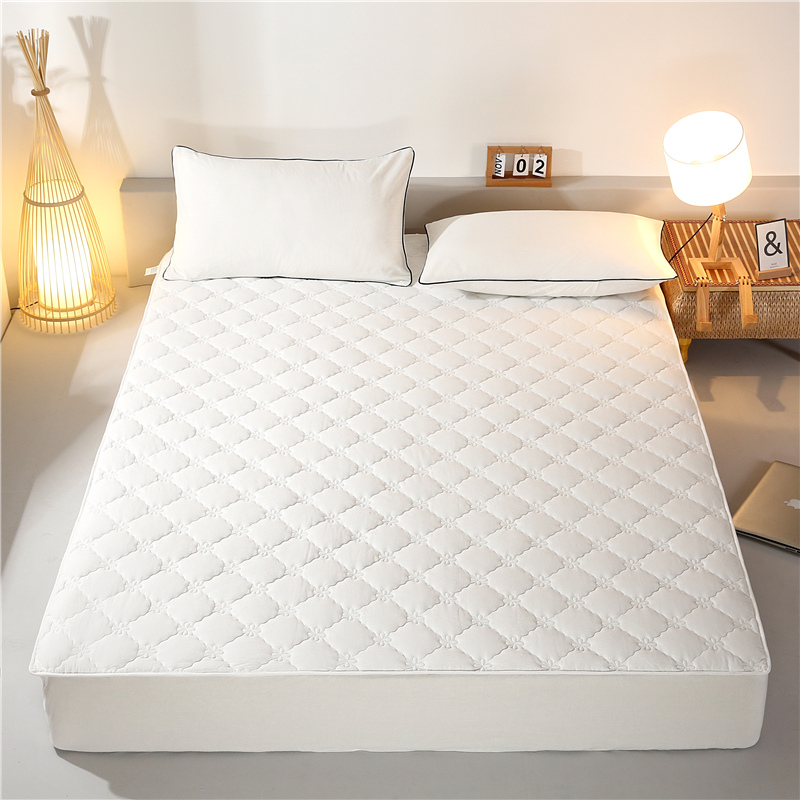
 Check-Quilt Microfiber Topper with 40s Downproof FabricA quilted microfiber topper using 40s downproof fabric and a wavy diamond design, suited to buyers weighing fill containment and quilting construction.View Product →
Quilting pattern is the other underrated detail. A check-quilt or channel-quilt construction anchors the fill in place, so the topper does not migrate into a lump in the middle of the bed after a month. Dense quilting feels slightly firmer because the stitching compresses the fill in lines; looser quilting feels plusher but needs better fill distribution to avoid cold spots. If you have ever owned a topper that developed bald patches, you already know why this matters.
Finally, consider noise. Some synthetic shells rustle audibly every time you move, which is maddening in a quiet room. Cotton shells are quiet. It is a small thing until it is the only thing you can hear at midnight.
Down and Feather, or Microfibre? A Two-Column Answer
This is the decision most shoppers get stuck on, so here it is laid out as a straight comparison between the question people ask and the answer we usually give.
Which feels softer?
Down and feather feels softer in the first minute, because it sinks and surrounds the body. Microfibre feels softer over a whole night for many sleepers, because it recovers instead of collapsing into a hollow.
Which is better for a hot sleeper?
Microfibre, generally, especially with a cotton downproof cover. Down traps warmth efficiently, which is lovely in winter and less lovely in a heated bedroom.
Which lasts longer?
A well-filled microfibre topper usually holds its loft longer under daily use. Down needs regular shaking and airing and gradually loses loft as feathers break down.
Which is easier to clean?
Microfibre, by a wide margin. Many microfibre toppers tolerate machine washing on a gentle cycle; down usually requires professional cleaning or very careful home washing with a long drying time.
Which should an allergy sufferer choose?
Microfibre, unless the down product carries a credible downproof shell and a clear cleaning routine. Dust mites are the usual culprit rather than the down itself, but the easier washability of microfibre matters.
Which feels more like a hotel bed?
Down and feather, if the hotel feel you remember is a deep, enveloping cloud. If what you remember is a crisp, smooth, slightly springy surface, microfibre gets you closer.
Our own production leans heavily towards microfibre for hotel use, not because it is cheaper, but because it survives commercial laundering and keeps its shape in rooms where guests rotate every night. At home, that same durability argument holds, just more gently.
Matching the Topper to How You Actually Sleep
Sleeping position is the most practical filter after fill type. The same topper that feels wonderful to a back sleeper can leave a side sleeper with a numb arm, and vice versa.
Side sleepers
You need give at the shoulder and hip without a valley at the waist. A 7cm microfibre or a soft latex topper is usually ideal. Memory foam works too, provided it is not so dense that your shoulder cannot sink.
Back sleepers
You want softness on the surface and support underneath. A 5cm topper is often enough. Going too thick can push the hips up and flatten the lower back, which is the opposite of comfortable.
Stomach sleepers
Keep it thin. A 3cm to 5cm topper takes the hardness off without lifting the hips into an arch. Anything deeper tends to push the pelvis down and strain the neck.
Hot sleepers
Choose breathable materials and avoid dense memory foam. A cotton-covered microfibre topper plus a breathable pillow, such as a height-adjustable pillow with a layered fill, makes a bigger difference to night temperature than most people expect.
Couples with different preferences
A single medium-soft topper is the usual compromise. Where the gap is large, a zippered two-layer design lets each side be adjusted independently without buying two separate products.
Restless movers
You will dislike a topper that leaves a body-shaped dent. Latex and springy microfibre recover quickly; slow-response memory foam does not.
Topper, Pad or Protector? Getting the Layers in the Right Order
Part of the confusion around softening a bed comes from three products that sound interchangeable and are not. Getting them in the right order prevents a lot of wasted money.
Fitted sheet, the layer you actually touch
Mattress topper, the softening layer, typically 5cm to 10cm
Mattress protector, the thin waterproof or quilted barrier
The mattress itself, which provides support
A mattress protector sits directly on the mattress and exists to keep it clean and dry. It adds a millimetre or two of comfort at most. A mattress pad is a thin quilted layer, usually under two centimetres, that smooths the surface but does not meaningfully change firmness. A mattress topper is the thick, filled or foamed layer that actually changes how the bed feels.
If you already use a waterproof protector, put the topper above it, not below. Otherwise the protector's membrane sits between you and the cushioning, and you lose much of the benefit. If your mattress is under warranty and the manufacturer requires a protector, keep it in place and add the topper on top.
- Hard bed, no other complaints: topper only.
- Hard bed plus spills or pets: protector first, then topper.
- Slightly hard bed and you want a crisper surface: a thick quilted pad may be enough.
- Bed that sags: no topper will fix it, and a thick one will simply follow the sag.
When One Firmness Does Not Suit Two People
The most common household objection we hear is some version of "I want it softer, my partner thinks it is already too soft." This is a real problem, and it is the reason layered and zippered topper constructions exist.
 Zippered Double-Layer Microfiber Mattress TopperA two-layer microfiber topper with a zip, offering adjustable filling and a way to balance different firmness preferences between sleepers.View Product →
A double-layer topper with a zip lets you open the shell and add, remove or redistribute filling. In practice, that means one side can sit at a plush 8cm while the other stays at a supportive 5cm, using the same product. It also means the topper can be adjusted seasonally, which is more useful than it sounds: many people want more cushioning in winter and a firmer surface in summer.
If you are buying for a guest room, adjustable construction is even more valuable, because you have no idea how the next visitor sleeps. Hotels solve this with a mattress that is deliberately firm and a topper that can be swapped per room category, which is a strategy worth borrowing at home if you have more than one bed to manage.
Care, Washing and Rotation: Keeping the Softness You Paid For
A topper is a consumable, but a good one should give you several years of comfortable sleep. Most of the complaints we hear about toppers losing their softness within a year trace back to care rather than manufacturing.
Daily
Pull the covers back for twenty minutes before making the bed. This lets moisture escape and helps the fill recover its loft.
Weekly
Shake the topper from the corners and smooth it flat. If it has channels or quilting, run a hand along each one to redistribute the fill.
Monthly
Rotate head-to-foot. This is the single most effective thing you can do to prevent a body-shaped dent forming in one spot.
Every few months
Air it near an open window, away from direct sun. Sunlight degrades fibres and yellows cotton covers.
When it needs washing
Follow the care label. Use a gentle cycle, a mild detergent and a low spin. Dry thoroughly, ideally with dryer balls, before putting it back on the bed, because damp fill clumps and stays clumped.
Two warnings. First, never wash a memory foam topper in a machine; the foam breaks down and the cover rarely survives. Second, feather and down toppers need a long, low drying cycle with something inside the drum to break up clumps, and they should never be stored compressed in a bag for months. Our hotel clients store toppers flat on shelves for exactly this reason.
What Hotels Do Differently, and What Is Worth Copying
Hotels are obsessive about the top three centimetres of a bed, and for good reason: that is where the guest's first impression forms. A few of their habits translate directly to a home bedroom.
- They separate support from softness. The mattress is chosen for durability and support, and the comfort layer is chosen separately. At home, this means you can keep a firm mattress and add softness rather than replacing the whole thing.
- They build in layers. Protector, topper, then linen. Each layer has one job, which makes it easy to replace the one that wears out first.
- They buy the cover quality, not just the fill. A downproof cotton shell is standard in good hotel bedding because it survives repeated laundering without shedding fill.
- They standardise on white. It shows cleanliness, it hides nothing, and it makes mismatched replacements less obvious. The same logic applies at home.
- They replace on a schedule. Hotel toppers are rotated and retired before guests notice a problem. At home, if your topper is more than five years old and has gone flat in the middle, it is probably time.
If you want to go one layer deeper into how hotel bedding is put together, our guide to building five-star comfort with a down duvet walks through the duvet side of the same equation, including fill power and tog choices that pair well with a softer mattress surface.
A Practical Checklist Before You Buy
Run through this list in order. It takes about two minutes and will save you from most of the common mistakes.
Measure the mattress, not the bed frame
Topper sizes follow mattress dimensions. A deep mattress in a standard frame may need a slightly larger topper to avoid a visible gap at the edges.
Decide how much softer you want
Mild: 3cm to 5cm. Noticeable: 5cm to 7cm. Complete change: 7cm to 10cm.
Check the fill weight, not just the height
A thick topper with a light fill flattens quickly. Ask for gram weight per square metre where possible.
Read the cover specification
Cotton, downproof, quiet, breathable. Avoid loose synthetic shells that pill, rustle and trap heat.
Confirm washability
If it cannot be washed or aired easily, it will be retired early. Check the label before buying, not after.
Check the return window
Softness is personal. A two-week trial at minimum is worth more than any specification sheet.
Frequently Asked Questions
What is the best mattress topper to make a bed softer?
For most people, a microfibre-filled topper of around 5cm to 8cm with a cotton downproof cover offers the best balance of softness, breathability and durability. If you want the deepest, most luxurious sink, down and feather is the softer option, but it needs more maintenance and sleeps warmer.
How thick should a topper be to noticeably soften a firm mattress?
Five centimetres is the point at which most sleepers notice a real difference. Seven centimetres feels genuinely plush. Ten centimetres is for very hard or older mattresses, or for people who want a dramatic change in how the bed feels.
Will a topper make my bed too soft and hurt my back?
It can, if you choose a very thick topper on an already soft mattress. If your mattress is firm and supportive, adding 5cm to 7cm of softness is unlikely to cause problems. If the mattress sags, fix that first, because a topper will follow the sag rather than correct it.
Are memory foam toppers good for softening a bed?
They are excellent for pressure relief, especially for side sleepers with shoulder or hip pain. The trade-off is heat retention and a slower, more "stuck" feeling. Gel-infused versions reduce the warmth slightly but do not eliminate it.
Can a topper be used on a sofa bed?
Yes, and it is one of the best uses for a thinner topper. A 5cm topper turns most sofa beds from a compromise into something genuinely sleepable, and it can be rolled away when the bed is folded up.
How do I stop a topper from sliding?
Use a fitted sheet over both the topper and the mattress with deep enough pockets, or look for a topper with an elasticated skirt or a textured base. A smooth topper on a smooth protector will always shift a little.
Do I need a topper if I already have a mattress pad?
Only if the pad is not doing enough. A pad is usually under two centimetres and smooths the surface; a topper is thick enough to change the firmness. If you can still feel hardness through the pad, you need a topper.
How often should a mattress topper be replaced?
Every three to five years for most filled toppers, and five to seven years for latex. Replace sooner if it has developed a permanent dent in the middle or if the fill has migrated to the edges despite regular rotation.
News
-
Hotel Duvet Materials: Microfiber vs Down Explained Introduction to Hotel Duvet Materials Hotel duvets are more than just bedding; they are a critical component of the guest experi...
READ MORE -
Why That Hotel Bed Feels Like Sleeping on a Cloud There's a particular moment every traveler knows. You pull back the crisp white sheets of a luxury hotel bed, sink into the mattre...
READ MORE -
Why Choose Hotel-Style Bedding? Choosing a hotel-style bedding set is one of the easiest ways to instantly elevate your bedroom into a calm, luxurious retreat. Here’s why millions ...
READ MORE

Product List
 Hotel Bedding Set
 +86-180 6864 1189
 +86-(0)513 86311444

 F Zone Chuanjiang Industrial Area, Tongzhou, Nantong City, Jiangsu Province, China
