 English
 русский
 Español
 عربى
عربى
Home / News / Industry News / All Season vs Lightweight Down Comforter: A Hotel Bedding Buyer's Guide
All Season vs Lightweight Down Comforter: A Hotel Bedding Buyer's Guide


All Season vs Lightweight Down Comforter: A Hotel Bedding Buyer's Guide
2026-09-14
Content
When a hotel procurement team reviews comforters for a new property, the specification sheet usually lists two common options: an all-season comforter and a lightweight down comforter. Both are designed for year-round use, but they solve different problems. The all-season comforter is a midweight product meant to handle a wider temperature range. The lightweight down comforter is thinner and relies on the insulating quality of down to keep warmth in without adding bulk.
The conclusion first: for most mid-range and upscale hotels, the decision is not "which is better" but "which matches your climate control strategy." If guest rooms have individual thermostats and you want one SKU that works across seasons, an all-season comforter is the safer stock. If your property is in a warm region or your guests consistently ask for lighter bedding, a lightweight down comforter delivers comfort with less storage and weight. Hotels in moderate climates often carry both and swap them seasonally.
What "All Season" and "Lightweight" Actually Mean
All season is a marketing term with no universal standard, but in the hotel bedding trade it usually refers to a fill weight around 300 to 400 grams per square meter in microfiber, or roughly 25 to 35 ounces of down fill in a king size. Lightweight products drop to about 200 to 250 gsm in microfiber, or 15 to 20 ounces of down fill. The actual difference is fill density, not fabric type. You can have a lightweight down comforter and an all-season microfiber comforter, and they will feel completely different on the bed.
A quick comparison table gives the typical specs.
| Spec | All Season Comforter | Lightweight Down Comforter |
|---|---|---|
| Fill weight (king) | 300 to 400 gsm or 25 to 35 oz down | 200 to 250 gsm or 15 to 20 oz down |
| Typical use | Year-round in temperate climates | Warm climates or hot sleepers |
| Warmth level | Midweight | Light to medium |
| Storage demand | Moderate | Lower |
| Laundering cycle | Standard | Easier to dry |
For procurement, the number that matters most is the fill weight per size. It tells you how much insulation the comforter actually provides. It also affects guest perception. An all-season comforter feels substantial when you sit on the bed, while a lightweight down comforter drapes more like a blanket.
How Climate and Guest Expectations Shape the Decision
A hotel in the southern United States or the Gulf region will almost always have better performance from a lightweight comforter. The guest room HVAC unit typically runs cooling most of the year, and a heavyweight comforter can trap heat that the air conditioning cannot remove. In this context, a lightweight down comforter gives the guest a soft, breathable layer without creating a hot microclimate.
In northern or mountainous regions, the opposite applies. A property in a cold climate needs an all-season comforter to handle nights when the heating system lets the room drop below 18 degrees Celsius. Guest expectations also play a role. Business travelers in a four-star property expect a comfortable, substantial duvet. A thin layer can read as low-cost or unfinished.
One useful solution for properties that face mixed seasons is a two-in-one comforter. It combines a light layer and a heavier layer that can be zipped together or used separately. This gives the hotel one SKU that works for summer, winter, and shoulder seasons, and it helps reduce the number of SKUs you need to store.
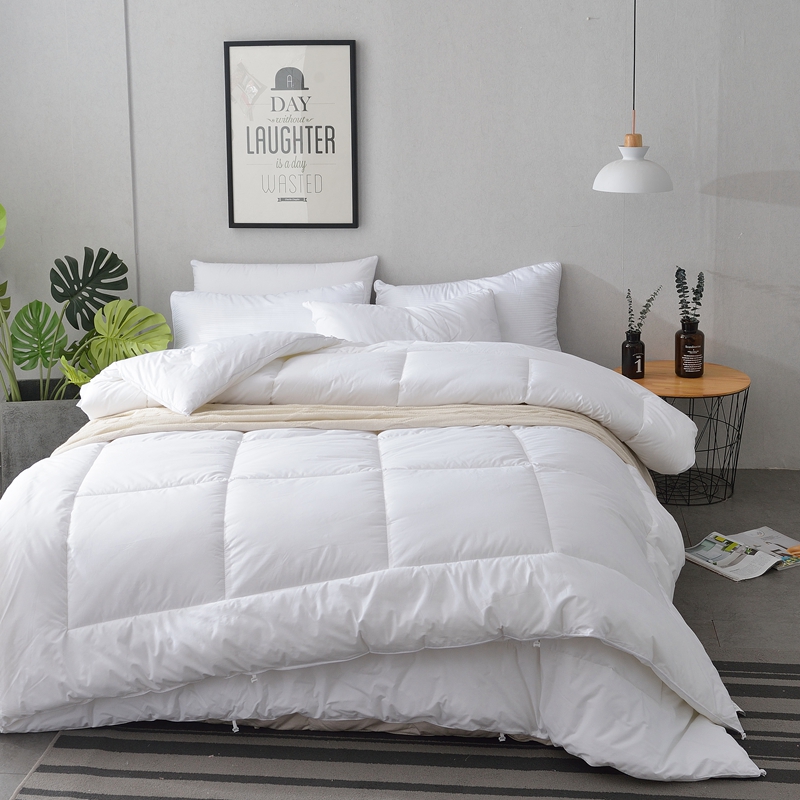 Two In One Duvet Light Weight And High Weight Two Pieces Can CombinedThis innovative system consists of two separate duvets—one lightweight and one heavier—that can be used individually or combined to create a single, ultra-warm duvet. ...View Product →
Down vs Alternative Fill: What Matters for Hotels
When the spec sheet says "down," the actual performance depends on fill power. Fill power measures the lofting ability of down, ranging from 500 to 800 cubic inches per ounce in hotel-grade products. Higher fill power means more warmth per gram, which is why a lightweight down comforter with 700 fill power can outperform a heavier comforter with lower fill power.
For a hotel, the practical benefits of down are breathability and weight. Down allows moisture to escape, which matters because hotel guests often sleep warmer than they expect. Down also compresses well, so laundry staff can store more comforters in a limited space. If you are evaluating a down option, review how to choose the right hotel duvet for luxury comfort to see how fill power and construction work together.
However, down has a higher initial purchase price and requires careful laundering. A low-cost alternative is microfiber filling. Microfiber is hypoallergenic, dries faster, and is more tolerant of industrial washing. It also comes in a wide range of fill weights, making it easy to specify an all-season version at a lower cost. Many five-star properties still choose down for the guest room, while using microfiber for extra beds, sofa beds, and budget rooms.
A duck down comforter with a 100% cotton shell gives the warmth and breathability of down while keeping the construction simple.
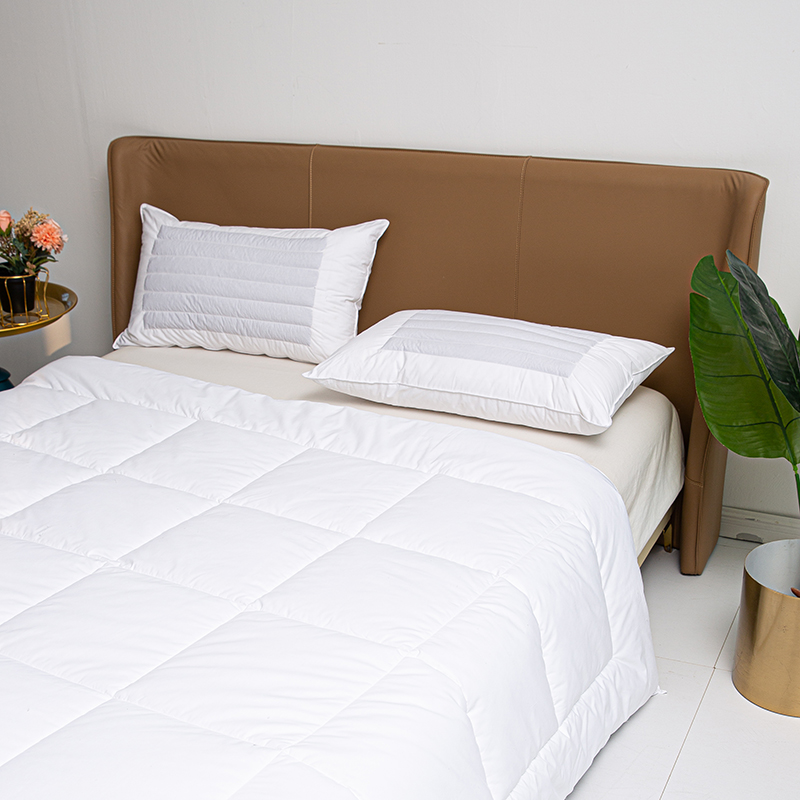
 Duck Down Warm Soft Duvet With Piping 100% CottonDuck down is warm and soft, and the 100% cotton duvet has been carefully selected for its core filling. Duck down, a natural thermal insulation material gifted by natu...View Product →
Sourcing: Fill Power, Construction, and Fabric
Beyond fill weight and fill type, three factors affect how the comforter behaves on a guest bed.
- Construction. Baffle box construction uses fabric walls that keep the down from shifting, which is a better choice for an all-season down comforter. Sewn-through construction is lighter and more common in comforters with lower fill weights, and it is also less expensive to manufacture.
- Fabric. A 100% cotton shell with a thread count of 300 or higher helps prevent feathers from poking through. A down-proof fabric is a must if you specify down; without it, hotel housekeeping will notice feathers on the floor within the first month.
- Washability. A lightweight duvet with a lower fill weight will dry faster, which matters if your laundry facility is small or your P&L is sensitive to energy costs. An all-season comforter takes longer to dry, so you may want to confirm whether your dryer can handle the load.
For properties in warm climates or for summer bedding rotations, a lightweight comforter with 300g filling on a 100% cotton shell is a straightforward choice. It provides just enough warmth for a guest room set at 21 degrees Celsius. For deeper technical detail, the ultimate guide to hotel down duvet comfort covers fill power and sizing in more depth.
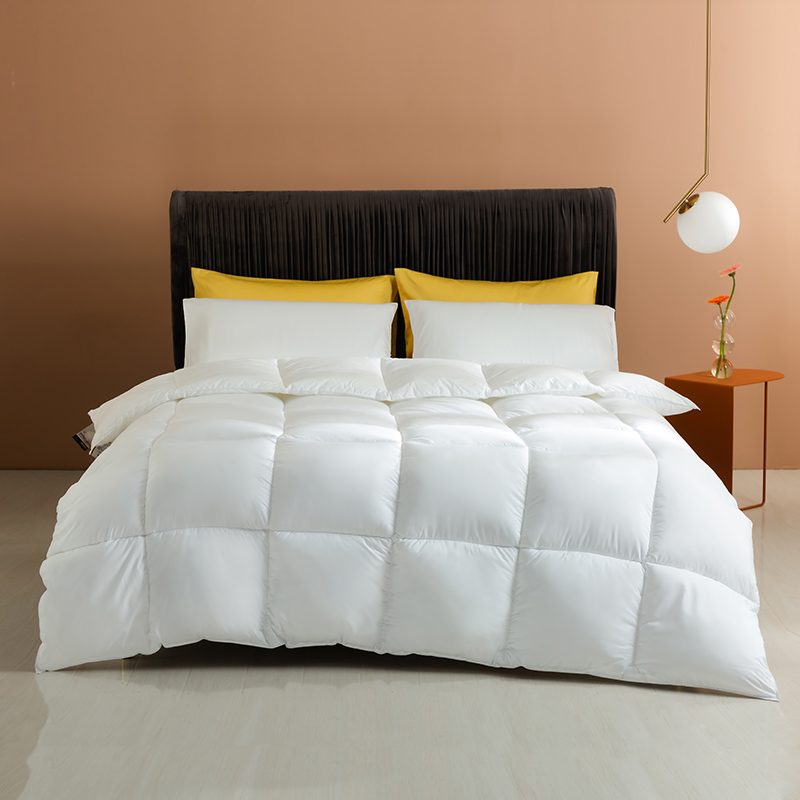
 100% Cotton 300gms Filling Duvet Summer Duvet Quilted White Duvet Set ManufactureThe core of this duvet set is 100% cotton. Known for its ability to regulate body temperature, cotton is ideal for bedding. It's soft against the skin and breathable, ...View Product →
A Practical Decision Framework for Hotel Operators
Let us sum up with a decision table that procurement teams can apply directly to their properties.
| Scenario | Recommended Option | Why |
|---|---|---|
| Warm climate, year-round cooling | Lightweight down comforter | Prevents overheating, lighter drying load |
| Cold climate, winter heating | All-season comforter | Provides sufficient warmth at night |
| Mixed seasons, limited storage | Two-in-one or all-season | One SKU handles multiple temperature zones |
| Budget-conscious hotel | Microfiber all-season | Lower cost, easier care |
| Guest complaint about weight | Lightweight down comforter | Feels lighter and more breathable |
The key is to confirm the climate and the number of guests. For a property that runs large in one season, the practical answer is often to stock a lightweight down comforter for warm months and add a blanket layer in colder months. That combination has been used for years in hotels with central climate control. It also keeps the bedding weight low for the end of the season.
The best comforter specification for your hotel is a decision about your climate, your HVAC, and your laundry capacity. When comparing all-season and lightweight down comforters, do not rely on the label. Check fill weight, ask for the fill power specification, and test how the comforter performs after a full industrial wash cycle. If you are buying for a property in a warm region, err on the side of lightweight. If your hotel faces winter conditions and the guest rooms have individual temperature controls, an all-season comforter will keep more guests comfortable. And if your storage space is limited, a two-in-one duvet is a flexible compromise that many hotel suppliers now offer.


News
-
Hotel Duvet Materials: Microfiber vs Down Explained Introduction to Hotel Duvet Materials Hotel duvets are more than just bedding; they are a critical component of the guest experi...
READ MORE -
Why That Hotel Bed Feels Like Sleeping on a Cloud There's a particular moment every traveler knows. You pull back the crisp white sheets of a luxury hotel bed, sink into the mattre...
READ MORE -
Why Choose Hotel-Style Bedding? Choosing a hotel-style bedding set is one of the easiest ways to instantly elevate your bedroom into a calm, luxurious retreat. Here’s why millions ...
READ MORE

Product List
 Hotel Bedding Set
 +86-180 6864 1189
 +86-(0)513 86311444
 F Zone Chuanjiang Industrial Area, Tongzhou, Nantong City, Jiangsu Province, China