 English
 русский
 Español
 عربى
عربى
Home / News / Industry News / Why Does a Hotel Microfiber Duvet Feel So Much More Luxurious Than a Standard One?
Why Does a Hotel Microfiber Duvet Feel So Much More Luxurious Than a Standard One?


Why Does a Hotel Microfiber Duvet Feel So Much More Luxurious Than a Standard One?
2026-04-20
Content
The Secret of High-Denier Microfiber
To understand the luxury of a hotel microfiber duvet, one must first look at the microscopic measurement known as “denier”—the thickness of individual filaments. Standard microfiber duvets found in big-box stores often use thicker, shorter fibers (above $1.0\text{ denier}$) that, while functional, can feel stiff, “plastic-like,” or clammy over time. These cheaper fibers lack the subtlety required for a true luxury experience.
Ultra-Fine Filaments and the “Peach-Skin” Finish
Hotel-grade microfiber is engineered with ultra-fine filaments, often measuring below $0.5\text{ denier}$—roughly one-hundredth the thickness of a human hair. By utilizing these finer filaments, manufacturers can pack thousands of more fibers into the same square inch compared to standard retail versions. This extreme density creates a fabric that is incredibly soft to the touch, mimicking the “silky” glide and fluid drape of high-end goose down.
Furthermore, luxury hotel duvets undergo a proprietary finishing process called “peach-skin brushing.” During this stage, the surface of the microfiber fabric is lightly abraded by specialized machinery to create a soft, velvet-like nap. This microscopic “fuzz” prevents the duvet from feeling “slippery” or cold when you first enter the bed, providing that immediate sense of warmth and security.
Advanced Moisture Management and Air Permeability
A common misconception among consumers is that microfiber is inherently non-breathable, leading to overheating. While this is true for low-quality synthetics, high-end hotel microfiber utilizes multi-channel (capillary) fibers. These fibers are not solid cylinders; they have microscopic grooves that allow moisture vapor (sweat) to be wicked away from the body instantly. Standard microfiber lacks this capillary action, trapping sweat and leading to a “clammy” feeling. The luxury hotel experience is defined by staying “warm but not hot,” a balance achieved only through these advanced fiber geometries.
Construction Excellence: The Box-Stitch Secret
The tactile feel of a duvet is dictated as much by its “architecture” as by its filling. Standard retail duvets often use simple channel stitching or are loosely filled with large batting, leading to the dreaded “clumping” effect. Within a few weeks of use, the insulation can migrate to the corners, leaving frustrating cold spots in the middle of the cover.
Baffle Box Construction: Engineering Structural Loft
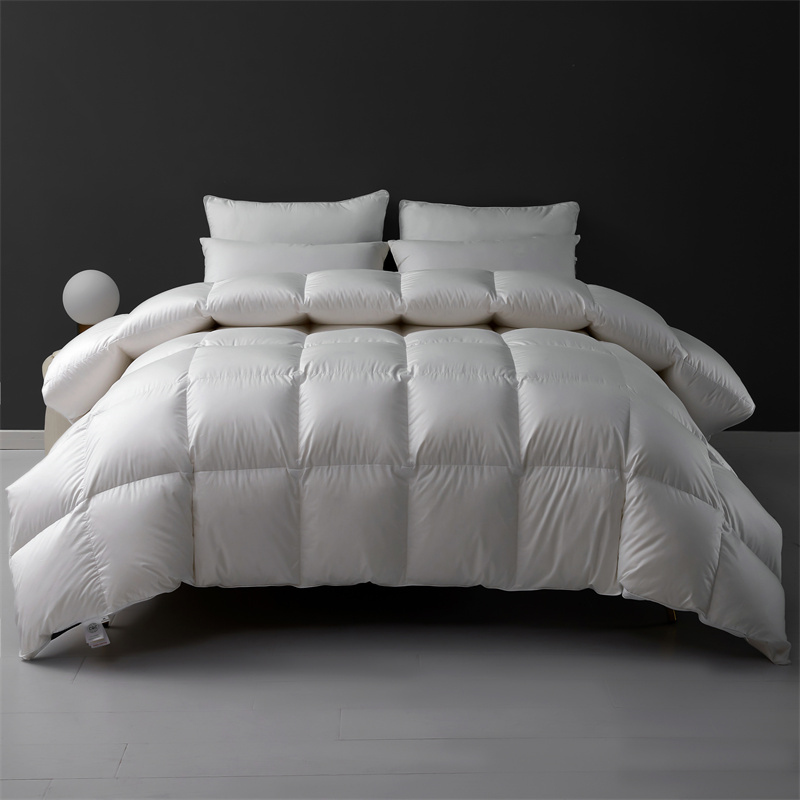
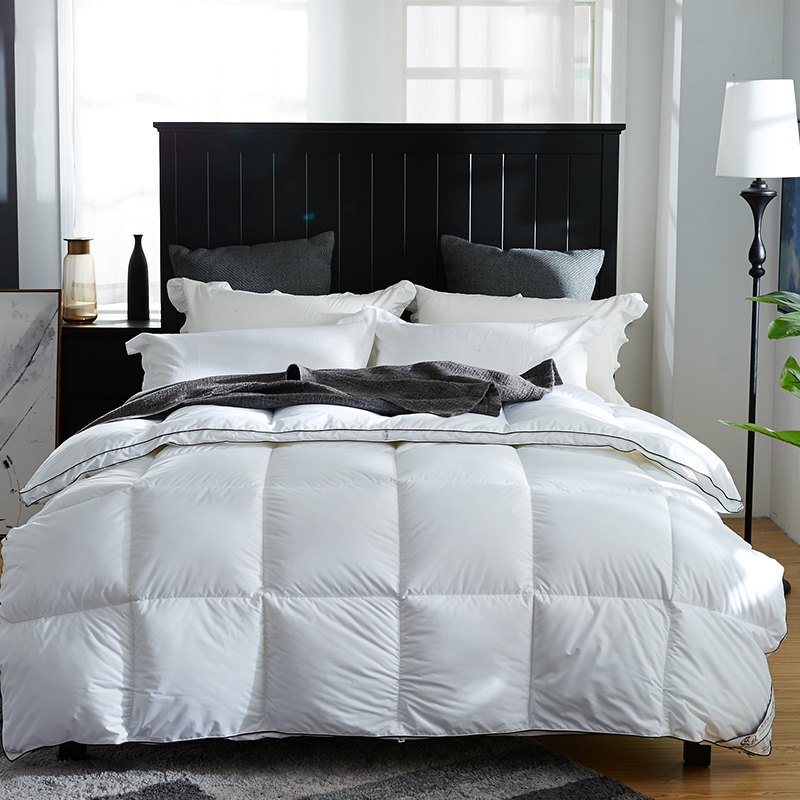
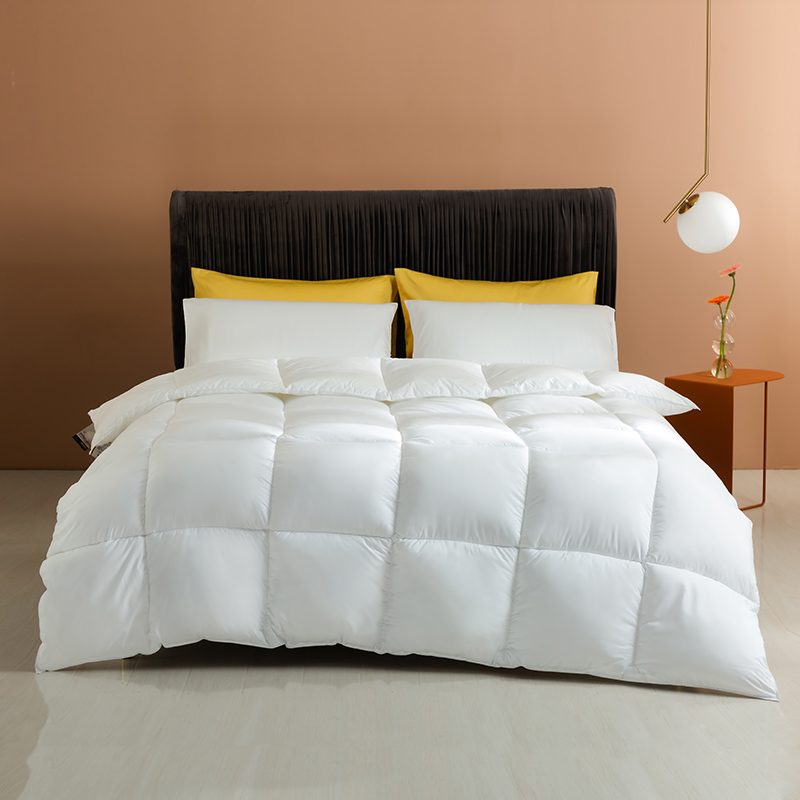
Luxury hotels almost exclusively utilize Baffle Box Construction (sometimes also referred to as Box-Stitch Quilted Construction). This technique involves sewing a grid of squares across the entire surface of the duvet. Each “box” acts as an independent chamber for the microfiber fill. More importantly, high-end construction often includes internal “baffle walls”—thin strips of fabric sewn between the top and bottom layers to create a true three-dimensional box. This configuration ensures:
- Even Distribution of Warmth: The microfiber fill cannot shift from one side of the bed to the other, providing consistent warmth across the entire body.
- Maximum Structural Loft: Baffle walls allow the microfiber to fully “fluff up” or loft, maintaining that “cloud-like,” plumped-up appearance that defines a luxury hotel room aesthetic.
- Durability for Industrial Laundering: Because the fill is locked securely in place, the duvet can withstand the rigorous industrial laundering processes required by hotels without losing its shape or insulating properties.
High-GSM (Grams per Square Meter) Selection and Psychological “Weight”
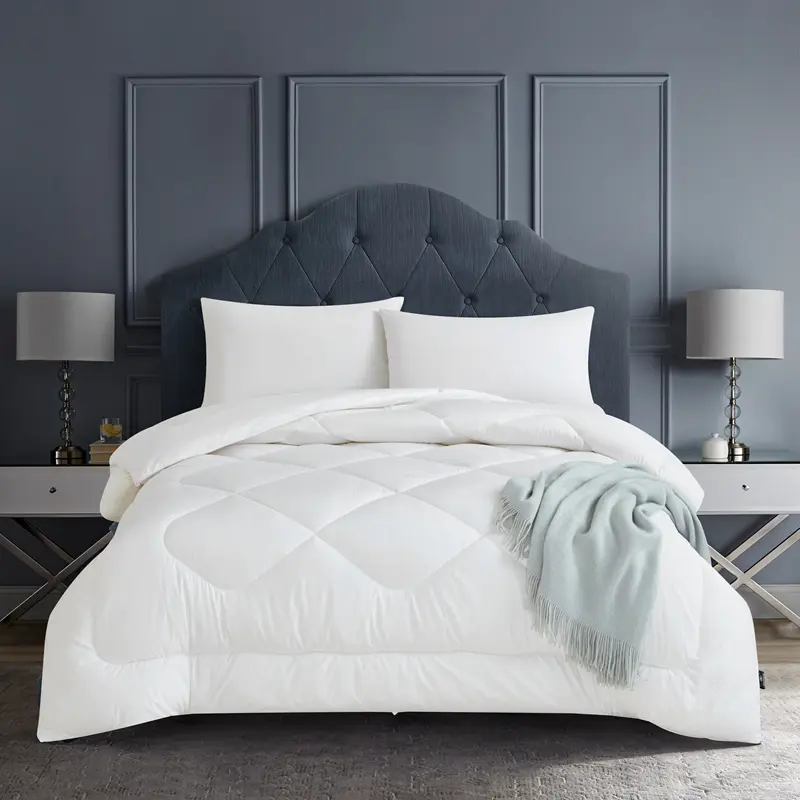
Hotels carefully select the total weight of their duvets based on the average climate of their region and the setting of their HVAC systems. While a “standard” home duvet might be a generic, lightweight $200\text{ GSM}$, a luxury hotel duvet is often customized. For a plush, “heavy” feel that provides a sense of “weight therapy” and security, hotels may opt for $350\text{ GSM}$ or even $450\text{ GSM}$ (in colder climates). This added weight, combined with the ultra-soft brushed microfiber, creates a “cocoon” effect that standard, lightweight retail duvets cannot replicate, making the sleeper feel physically comforted and anchored.
The Psychological Impact of Presentation and Prep
In the luxury hospitality sector, the guest experience is as much visual and auditory as it is tactile. Hotels understand that the “crunch” of a high-thread-count, crisp duvet cover over a soft, silent microfiber duvet signals “pristine cleanliness” and “superior quality” to the brain. Standard home duvets are often covered in limp Jersey knit or flannel, which muffles the duvet’s inherent loft and softness.
The Synergistic Interaction with the Duvet Cover
Standard home bedding often prioritizes convenient washing over tactile experience. Hotels, however, almost exclusively pair their high-GSM microfiber duvets with long-staple cotton percale duvet covers boasting a high thread count ($300\text{ T.C.+}$). The slight, energetic “crispness” of the percale cotton cover creates a beautiful physical tension against the ultra-soft, velvety microfiber interior. When the guest moves, this slight tension makes the duvet feel “alive,” “plump,” and “energetic” rather than flat, limp, or heavy. The cover allows the microfiber’s loft to express itself fully.
Rigorous Bulk Storage and Initial Plumping
Standard retail duvets often arrive at the consumer’s home vacuum-sealed and severely compressed for shipping efficiency. This extreme compression can permanently damage the molecular “spring” and structural memory of lower-quality polyester fibers, meaning they never truly recover their original factory loft. Hotels purchase in massive bulk and store their bedding in temperature-controlled, uncompressed environments. Before a duvet ever reaches a guest room, it is subjected to industrial “tumbling” and softening agents, and then meticulously “plumped” by housekeeping staff to preserve that crucial first “cloud-like” visual impact.
FAQ: Frequently Asked Questions
Q: Can I wash my hotel-style microfiber duvet at home without ruining it?
A: Yes, you can wash it at home, but you must avoid two critical mistakes. First, use a minimal amount of gentle detergent and zero fabric softener. Softeners coat the ultra-fine fibers, causing them to stick together and effectively “killing” the loft. Second, when drying, add 3-4 clean tennis balls or dryer balls to the cycle. This will “beat” the air back into the individual baffle chambers as the duvet dries, restoring its plumpness.
Q: Why is my home microfiber duvet starting to develop small, hard balls (pilling)?
A: Pilling is the primary failure mode for standard retail microfiber. It occurs when lower-quality, shorter synthetic fibers break, tangle, and form tiny balls on the fabric surface due to friction. Hotel-grade microfiber utilizes higher-tenacity, continuous-filament fibers that are far less prone to breaking and pilling, even after industrial washing.
References & Technical Literature
- Advances in Micro-denier Synthetic Filaments for Functional Hospitality Textiles, Textile Research & Innovation Journal (2025).
- The Thermodynamics of Bedding: Measuring Heat Retention vs. Air Permeability in Baffle Box Duvets, International Journal of Thermal Sciences.
- ISO 9073: Textiles – Test Methods for Nonwovens – Part 2: Determination of Thickness and Loft Retention.

News
-
Hotel Duvet Materials: Microfiber vs Down Explained Introduction to Hotel Duvet Materials Hotel duvets are more than just bedding; they are a critical component of the guest experi...
READ MORE -
Why That Hotel Bed Feels Like Sleeping on a Cloud There's a particular moment every traveler knows. You pull back the crisp white sheets of a luxury hotel bed, sink into the mattre...
READ MORE -
Why Choose Hotel-Style Bedding? Choosing a hotel-style bedding set is one of the easiest ways to instantly elevate your bedroom into a calm, luxurious retreat. Here’s why millions ...
READ MORE

Product List
 Hotel Bedding Set
 +86-180 6864 1189
 +86-(0)513 86311444
 F Zone Chuanjiang Industrial Area, Tongzhou, Nantong City, Jiangsu Province, China